 فارسی
 English
 العربیه
Fluxgate Magnetometer vs Hall Effect Sensor: Which Magnetic Sensor Is Right for Your Project?
The Importance of Magnetic Field Measurement
Accurate measurement of magnetic fields is essential in science, engineering, and advanced industry. From geophysical and satellite studies to robotics, motor control, and consumer electronics, magnetic sensors play a crucial role in enhancing system performance, precision, and reliability.
Among widely used technologies, the Fluxgate Magnetometer and the Hall Effect Sensor are two of the most prevalent. Selecting the right sensor requires a deep understanding of their physical principles, performance characteristics, advantages, limitations, and application areas.
This article provides a comprehensive technical analysis of these two magnetic sensing technologies, aiming to guide engineers, researchers, and industrial practitioners in choosing the most suitable sensor for their specific needs.
What Is a Fluxgate Magnetometer and How Does It Work?
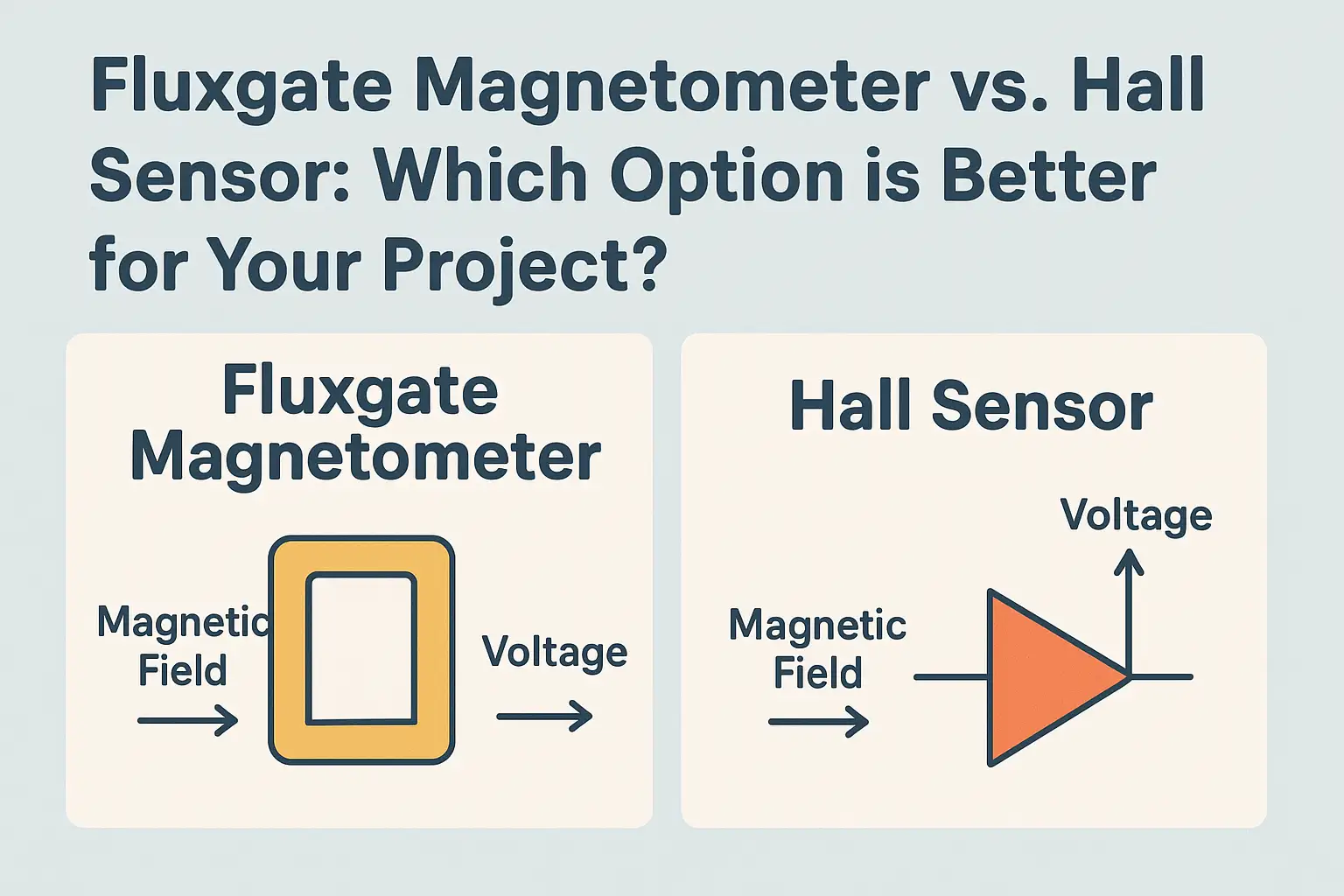
A fluxgate magnetometer is an active magnetic sensor based on the periodic saturation of a ferromagnetic core. Typically, the sensor consists of a high-permeability core (such as Permalloy or soft ferrite) with a drive coil and a sense coil.
Operating Principle
-
The drive coil applies an alternating current (AC) that periodically saturates and desaturates the core.
-
In the absence of an external magnetic field, the output of the sense coil contains no even harmonics.
-
When an external magnetic field is present, it disturbs the symmetry of core saturation, generating second or third harmonics in the output signal.
-
Signal processing extracts the magnitude and direction of the external magnetic field with high precision.
Key Advantage: The high-permeability core amplifies weak fields, enabling nanotesla-level sensitivity. Fluxgate magnetometers are considered the gold standard for low-field measurements in scientific and space applications.
What Is a Hall Effect Sensor and How Does It Work?
A Hall Effect sensor is a passive semiconductor-based sensor that operates on the Hall effect principle. When an electric current flows through a semiconductor material and a perpendicular magnetic field is applied, a transverse voltage, called the Hall voltage, develops. This voltage is directly proportional to the magnetic flux density.
Key Features of Hall Effect Sensors
-
Simple structure and compact size
-
Fast response time, suitable for dynamic measurements
-
Moderate sensitivity (millitesla to several tesla range)
-
Low power consumption, ideal for battery-operated or portable devices
Unlike fluxgate magnetometers, Hall sensors do not require a magnetic core or saturation; they produce a linear output relative to the applied magnetic field.
Fluxgate vs Hall Sensor: A Detailed Technical Comparison
Sensitivity and Resolution
Fluxgate Magnetometer:
-
Extremely high sensitivity, capable of detecting fields as low as 0.1 nT
-
Suitable for Earth's magnetic field measurements (~50 μT) and subtle magnetic variations
-
Preferred for laboratory and scientific applications
Hall Effect Sensor:
-
Moderate sensitivity, typically in the mT range
-
Suitable for medium-to-strong fields in industrial applications
-
Less effective for low-field measurements
Noise Performance
-
Fluxgate: Very low intrinsic noise, enabling high-precision measurements
-
Hall Sensor: Higher intrinsic noise due to semiconductor carrier fluctuations
Thermal Stability
-
Fluxgate: Relatively stable across temperature variations; can operate reliably in controlled environments
-
Hall Sensor: Strong temperature dependence; thermal compensation is often necessary to maintain accuracy
Bandwidth and Response Speed
-
Hall Sensor: High bandwidth and fast response, ideal for dynamic applications such as motor control and current sensing
-
Fluxgate: Lower bandwidth due to AC excitation; less suitable for high-frequency measurements
Power Consumption and Circuit Complexity
-
Fluxgate: Higher power consumption due to drive coil; requires complex signal processing
-
Hall Sensor: Low power, simple circuitry; ideal for mass-produced or portable devices
Size and Cost Considerations
-
Fluxgate: Larger size and higher cost; MEMS-based miniaturized versions exist but remain more expensive than Hall sensors
-
Hall Sensor: Small, cost-effective, and easily integrated into compact systems
Specialized Applications of Fluxgate Magnetometers
Fluxgate magnetometers are ideal for applications requiring high sensitivity and low noise:
-
Geomagnetic studies and Earth field mapping
-
Satellite and space exploration missions
-
Subsurface and mineral exploration
-
Laboratory noise monitoring in physics experiments
-
Advanced navigation and security systems
The fluxgate’s ability to measure extremely weak DC magnetic fields makes it indispensable for scientific and space-grade instrumentation.
Specialized Applications of Hall Effect Sensors
Hall Effect sensors are widely used in industrial and consumer applications due to their speed, size, and cost advantages:
-
BLDC and PMSM motor control
-
AC/DC current sensing in inverters and power electronics
-
Proximity detection and rotary encoders
-
Consumer electronics: smartphones, laptops, magnetic switches
-
Industrial robotics and automation
Their compact size and fast response time make Hall sensors the go-to choice for dynamic magnetic field measurements in practical systems.
Advantages and Limitations
Fluxgate Advantages
-
Ultra-high sensitivity for low-field measurements
-
Excellent long-term stability and low drift
-
Low noise, suitable for high-precision research
Fluxgate Limitations
-
High cost and complex design
-
Higher power consumption
-
Larger form factor
-
Limited high-frequency response
Hall Sensor Advantages
-
Compact, low-cost, and easily integrated
-
Low power consumption
-
Fast response, ideal for medium-to-strong fields
-
Suitable for mass production
Hall Sensor Limitations
-
Moderate sensitivity, less effective in weak fields
-
Temperature-dependent output; requires compensation
-
Higher noise compared to fluxgate
Advanced Technical Analysis for Sensor Selection
When to Choose a Fluxgate Magnetometer
-
Measuring fields weaker than 10 μT
-
Projects requiring high resolution and long-term stability
-
Scientific, space, or geophysical applications
-
Low-noise measurement environments
When to Choose a Hall Effect Sensor
-
Measuring medium to strong fields (mT to T range)
-
Applications needing high-speed response and wide bandwidth
-
Limited space, weight, or power consumption
-
Industrial, commercial, and consumer applications
Additional Considerations
-
Nonlinearity: Fluxgates are inherently nonlinear but produce a linear output via harmonic extraction; Hall sensors are linear until they approach saturation.
-
External Magnetic Interference: Hall sensors are more susceptible to external field interference; fluxgates offer better immunity.
-
Harsh Environment Performance: Fluxgates perform reliably under vacuum, high radiation, and extreme temperature; Hall sensors remain robust but may suffer from increased drift and noise.
Fluxgate vs Hall – Which Is Best?
Fluxgate and Hall sensors are both essential magnetic sensing technologies, optimized for different application domains.
Fluxgate magnetometers excel in low-field precision, long-term stability, and noise-sensitive scientific applications. They are the preferred choice for research laboratories, geophysical surveys, and space missions.
Hall Effect sensors excel in high-speed response, low cost, and compact form factors, making them indispensable for industrial control, robotics, consumer electronics, and current sensing.
The optimal choice depends on magnetic field range, required accuracy, response speed, power budget, space constraints, and project cost. Understanding these parameters allows engineers to select the most suitable sensor technology for their specific project.